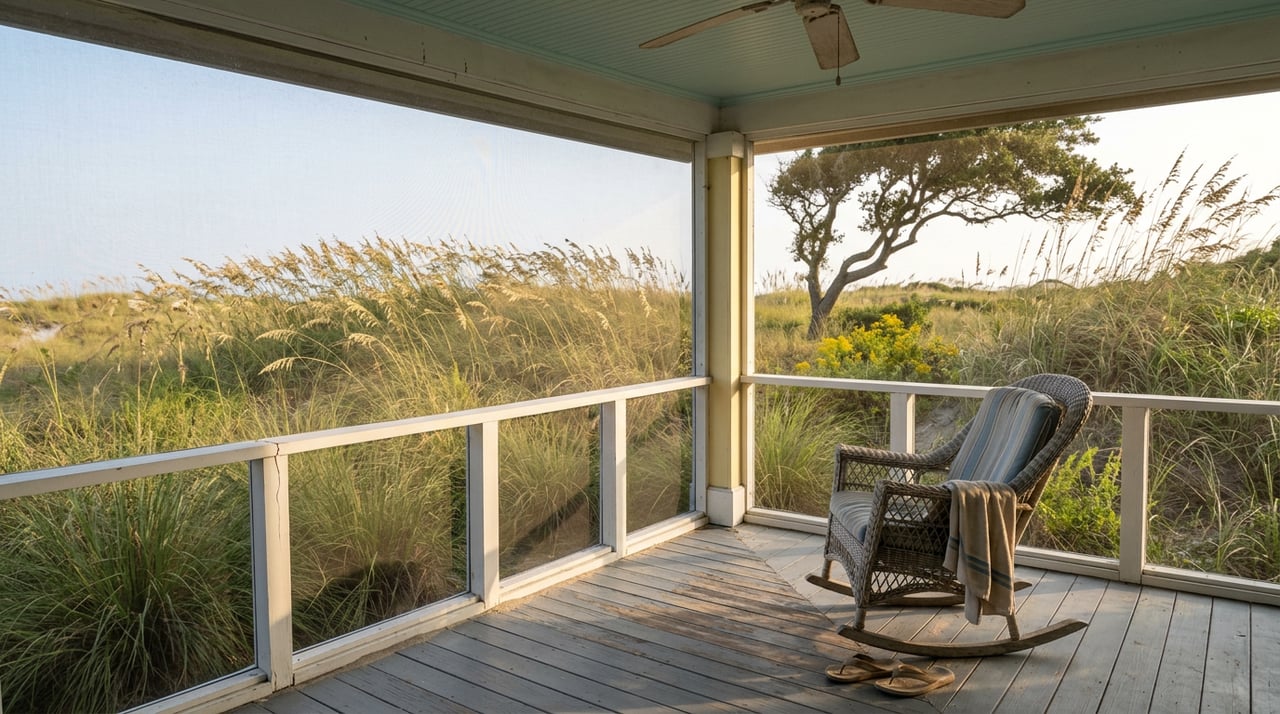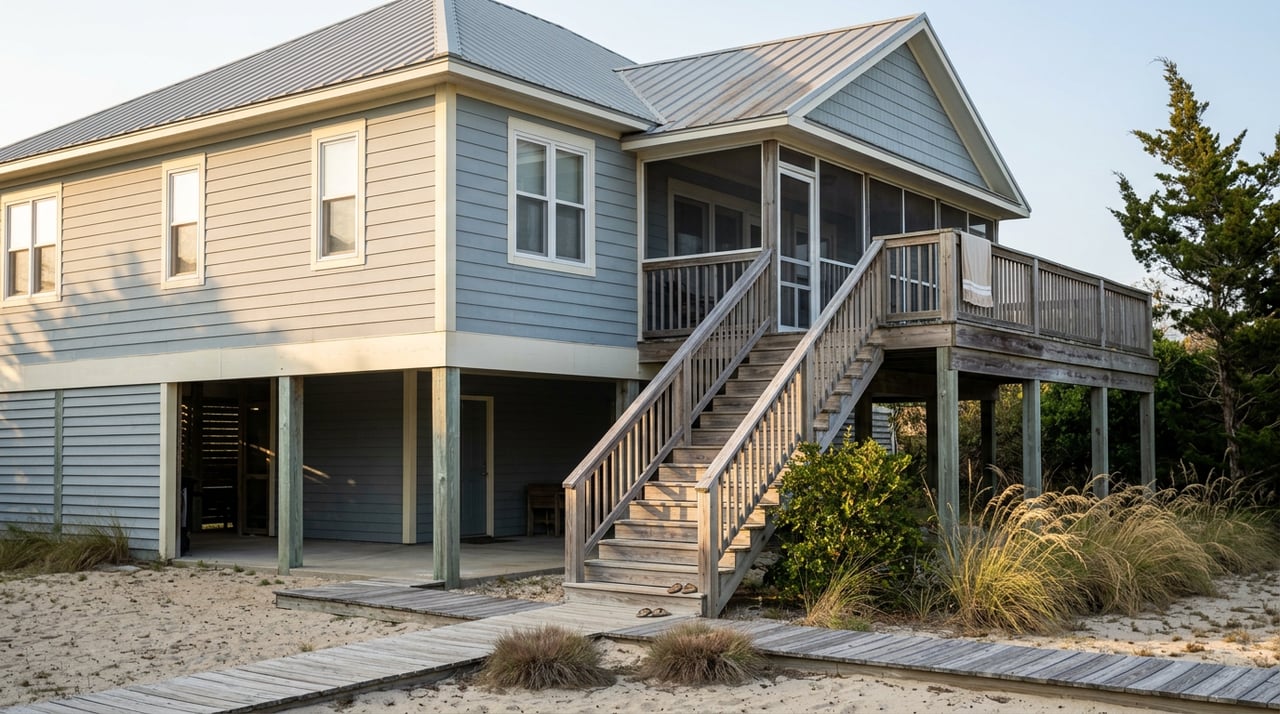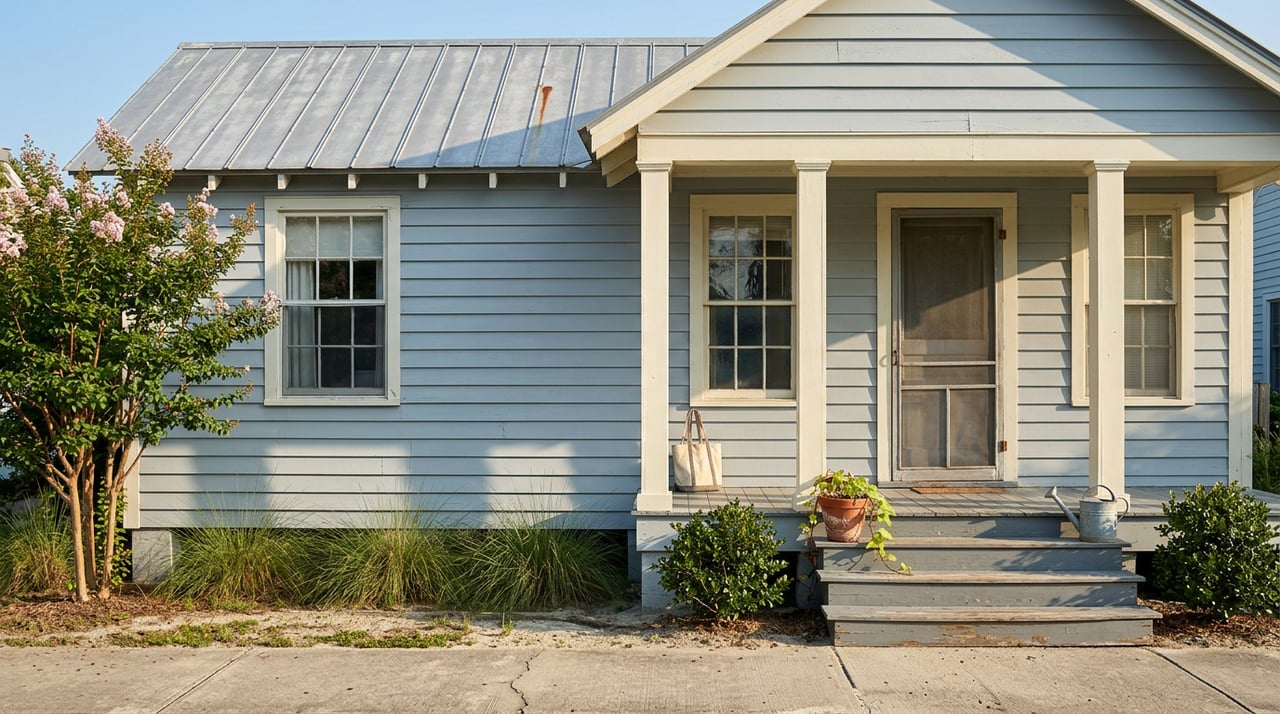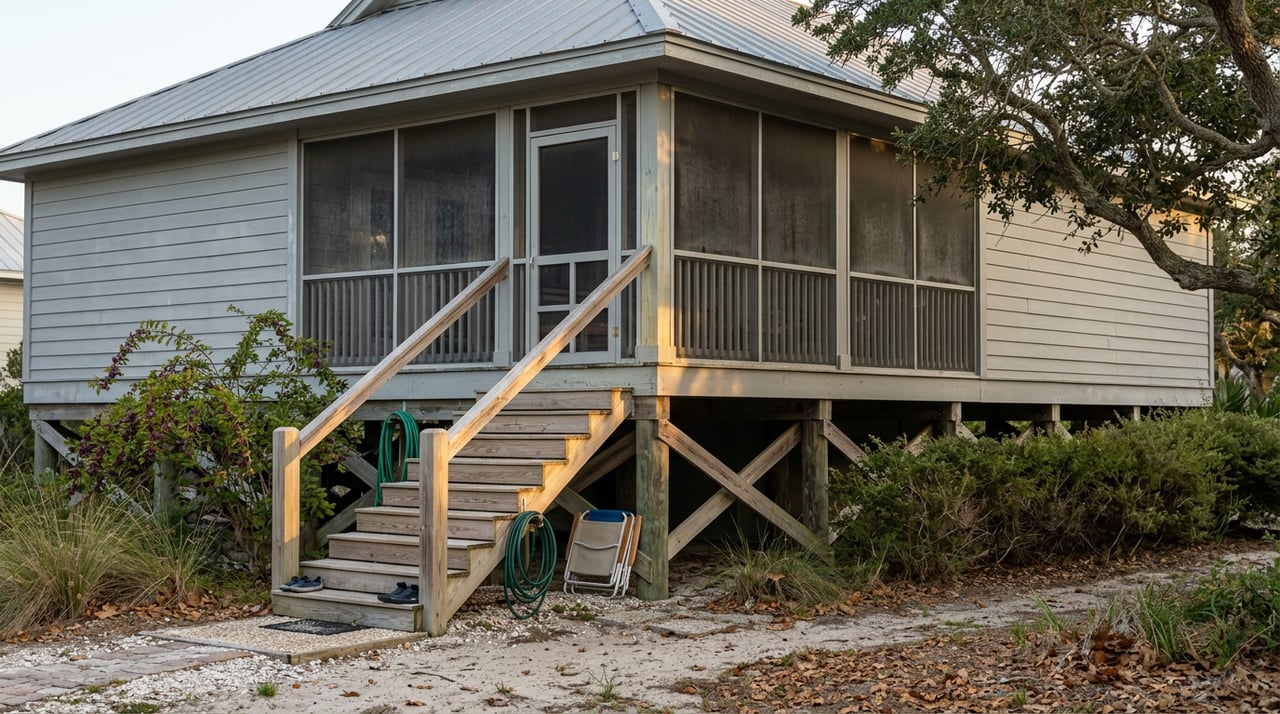
Drive north on NC-12 through Corolla and at some point the pavement just stops. There's no dramatic sign, no gate, just a ramp of packed sand where the road used to be. From there, the beach becomes the road for the next eleven miles, through Carova, Swan Beach, North Swan Beach, and Penny Hill, until you hit the Virginia state line. No stores. No gas stations. No trash pickup once you cross onto the sand. A single volunteer Fire and Rescue Station covers all 600-plus homes strung along that stretch.
If you've been searching "Corolla real estate" on any portal, you've seen a median list price somewhere around $660,000 to $674,000 as of July 2026, with an average around $416 to $427 per square foot. That number is real. It's also hiding something. Corolla isn't one housing market wearing one price tag. It's two markets sharing a town name, and the gap between them is being shaped by a buyer you probably didn't expect to be competing against: a nonprofit horse sanctuary.
Two markets, one town name
Everything south of where the pavement ends behaves like a fairly conventional beach town. Municipal-adjacent services, paved access, a median list price in the mid-$600,000s, average days on market running around 135 to 138 as of July 2026.
North of the pavement, in the 4WD-only zone, the range is wider and stranger. Small two- and three-bedroom cottages on the soundside start around $170,000, among the cheapest properties anywhere on the northern Outer Banks. At the other end, oceanfront homes along Ocean Pearl Road with eight, ten, or twelve-plus bedrooms routinely list above $900,000. Raw land in between can start around $20,000 for a lot with no road frontage at all, just sand.
A June 2026 market report drawn from Outer Banks MLS data noted that 33 of 517 active single-family listings across the entire Outer Banks that month sat inside Corolla's 4WD area specifically, and flagged it as a market that behaves differently from the rest of the region. That's the tell. When a submarket gets called out separately in a regional report, it means the comparable-sales math that works everywhere else doesn't hold up cleanly here.
| Paved Corolla | Carova / 4WD zone | |
|---|---|---|
| Typical price range | Roughly $660K–$674K median | $170K cottages to $900K+ oceanfront |
| Access | Paved NC-12 | Beach driving only, no roads |
| Utilities | Standard grid connections | Private well, septic, often solar |
| Emergency services | Municipal fire/EMS | Single volunteer station for 600+ homes |
| Land cost | Built-out, limited raw land | Lots from roughly $20K |
What the discount is actually paying for
The lower entry price in the 4x4 zone isn't a coupon. It's a transfer of cost and responsibility from the seller's side of the ledger to the buyer's.
Every home north of the pavement runs on private well and septic. That's standard for the community, not a red flag on its own, but it does mean a buyer inherits system maintenance that municipal water and sewer customers never think about. North Carolina has required point-of-sale septic inspections since 2008, performed only by an inspector certified through the state's Wastewater Contractors and Inspectors Certification Board, and the inspector has to confirm the home's bedroom count matches what the septic permit actually allows. In an area with older cottages built in the 1970s through 1990s, a converted bunk room or an added bedroom that was never permitted for the septic system is exactly the kind of thing that surfaces during due diligence, not before.
Financing adds its own layer. VA loans can work on off-grid or well-and-septic properties, since the VA's rule is about function rather than source: the home has to have potable water, working electricity, year-round heat, and a safe waste system, and it doesn't matter whether that power comes from a line or a panel. Where it gets complicated is when a home has a leased solar system rather than an owned one. A solar lease often comes with a UCC-1 filing, a recorded financial interest that can conflict with a lender's claim to first position on the property, and most lenders will require that lease resolved, subordinated, or paid off before they'll close. That's a conversation worth having with a lender before writing an offer, not after.
North Carolina's due diligence structure doesn't bend for any of this. Under the standard Offer to Purchase and Contract, the buyer pays a non-refundable due diligence fee directly to the seller, and that fee stays with the seller regardless of what an inspection turns up, unless the seller committed a material breach. A buyer can still walk away for any reason during the negotiated window, typically two to four weeks, but the fee doesn't come back just because the well test came back questionable or the septic permit doesn't match the bedroom count. Budgeting a few hundred dollars for a septic inspection and well test early in that window, rather than late, is standard advice everywhere in North Carolina. In a 4x4-only area, it matters more, because scheduling a certified inspector who can actually reach the property on a specific timeline takes coordination that a paved-road listing doesn't require.
The income side of the trade
None of this friction exists in a vacuum. Large oceanfront homes in the 4x4 zone can generate real rental income, and it's not a hypothetical. Listings for oceanfront homes in Carova have shown figures like $83,000 already booked for the current year and one property with more than $98,000 achieved the prior year and over $111,000 projected. That kind of yield is one reason serious investors accept the well, septic, and access friction that comes with the territory.
That math applies mostly to the large end of the market: the eight-plus-bedroom oceanfront rental homes built specifically for weekly guest turnover. It doesn't automatically apply to the $170,000 soundside cottage, which is a different kind of purchase entirely, closer to a quiet, low-cost second home than an income property.
The buyer competing for the same lots
Here's the part most people searching median prices never encounter. The land the 4x4 zone sits on isn't just naturally scarce because it's a barrier island. It's being actively kept scarce by an organization with a specific mission.
The Corolla Wild Horse Fund manages roughly 7,544 acres of habitat for the Banker horses that roam the northern beaches, land that's actually a mix of public and private ownership, with about 30 percent of it currently developed and more than 3,000 platted lots across the whole stretch. The fund has noted that new construction keeps creeping farther north each year, and it runs an active land preservation initiative that buys undeveloped parcels specifically to keep them out of the residential pipeline. In one documented case, horses were pictured resting and grazing on a piece of property that a full-time 4x4 resident had bought for exactly that reason: to keep it from being developed.
That means anyone shopping for raw land in the 4x4 zone as a long-term hold is competing, at least at the margins, with a nonprofit that has every incentive to buy the same parcels and never build on them. It's not a dominant force in every transaction, but it's a real bidder in a market where lot inventory was already tight. For a buyer thinking about land banking north of the pavement, that's a variable worth knowing about before assuming supply will simply grow to meet demand the way it might elsewhere.
What this means depending on what you're buying
If you're buying a primary residence or a straightforward vacation home in paved Corolla, most of this doesn't touch you. You're in a conventional market with conventional financing and a median price that means what it says.
If you're eyeing a rental investment in the 4x4 zone, get a lender who's comfortable with well, septic, and solar-financed properties lined up before you write an offer, and budget real time in your due diligence window for a certified septic inspection and a well test scheduled early, not on day thirteen of a fourteen-day period.
If you're looking at raw land as a hold, factor in that the pool of platted lots isn't just limited by geography. It's being drawn down over time by a buyer whose goal is permanent non-development.
A few questions that come up often
Do I need a permit just to drive to my own house in the 4x4 zone? Beach driving itself doesn't require a permit in the Corolla and Carova area, but parking on the beach does, and property owners who rent their homes need to provide guests with parking permits, typically two per house, available through the Corolla Visitors Center. For 2026, the seasonal parking permit requirement runs from the second Saturday in May through the last Saturday in September, with exact pricing and rules posted on the county's site each year.
Is the septic inspection different for a Carova home than for a home in paved Corolla? The state rules are the same everywhere in North Carolina. What changes is logistics. A certified septic and well inspector still has to physically reach the property, and in a 4WD-only area that can mean more coordination and lead time than a listing with a driveway off a paved street.
Can I actually get a mortgage on a home with no grid electricity? Yes, through certain loan programs, as long as the property's water, power, heat, and waste systems function reliably and meet code. The complication tends to be financial, not functional: a leased solar system can carry a recorded lien that needs to be cleared or subordinated before a lender will close.
If you're weighing a purchase anywhere between paved Corolla and the far end of Carova, it helps to have someone who's walked this specific stretch of market before, not just the Outer Banks in general. That's the conversation Gabe Stabley has with remote buyers every week, from pricing a soundside cottage against an oceanfront rental to lining up the right inspector before your due diligence clock starts running. Let's Connect.